
How do you start the second row when crocheting comes down to three sequential steps that need to happen in the right order: complete your turning chain at the correct height, physically turn your work, and correctly identify your actual first stitch based on your specific stitch type’s counting rule. I walk every new student through this exact sequence deliberately slowly, since rushing through it on the very first attempt is where most early counting errors begin. This guide breaks the process down in full detail, then gives a short practice drill to build the habit before you commit to a real project.
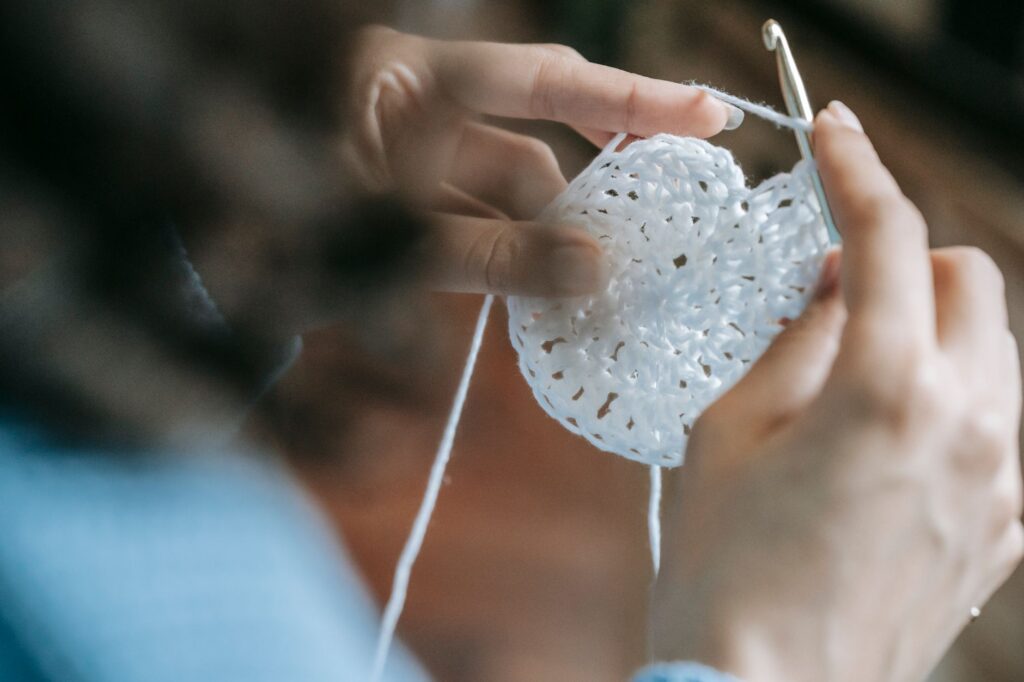
The Full Sequence, Step by Step
- Finish the last stitch of row 1 as your pattern directs.
- Chain the height appropriate for your stitch type: 1 for single crochet, 2 for half double crochet, 3 for double crochet.
- Flip your work over so the opposite side faces you, keeping your hook threaded through the last loop rather than removing it entirely.
- Determine whether your turning chain counts as your first stitch, based on your specific stitch type’s rule.
- If it does not count, as with single crochet, insert your hook into the actual first stitch of row 1 and begin working normally.
- If it does count, as with double crochet, skip the actual first stitch of row 1 entirely and insert your hook into the second stitch instead, treating the turning chain itself as your first stitch.
- Continue across the row, remembering that the very last stitch typically gets worked into the top of the previous row’s turning chain.
Why This Trips Up So Many Beginners
The core difficulty is that the rule genuinely changes by stitch type, so a habit built correctly on single crochet, where the chain never counts, actively causes mistakes the moment you switch to double crochet, where it does count. I have watched confident intermediate crocheters make this exact mistake switching stitch types after months of working exclusively in single crochet, simply because the old rule had become so automatic.

A Practice Drill to Build the Habit
Chain 15 and work four full rows in single crochet, counting your stitches out loud after each row and confirming all four rows land at 14 stitches. Once that feels automatic, repeat the same drill in double crochet, chaining 16 this time to account for the taller turning chain, and confirm your count stays consistent at 14 stitches across all four rows there too, remembering that the turning chain counts as a stitch this time.
Doing both drills back to back, rather than just one, specifically reinforces that the rule is not universal, which is the exact misunderstanding that causes trouble later when switching between stitch types mid-project.
How This Differs from Starting a New Row in Knitting
Knitters starting a new row simply turn the work and begin knitting the next stitch directly, with no equivalent turning chain step at all, since knitting’s live stitches sit ready on the needle regardless of direction. Crocheters coming from a knitting background sometimes expect an equally simple turn, which is part of why the turning chain height and counting rule feels like an extra, unfamiliar layer of complexity worth deliberately practicing rather than assuming it works the same way.
This usually means you are applying single crochet’s turning chain rule, where the chain never counts as a stitch, to double crochet, where it typically does count. Recheck the specific rule for whichever stitch you are currently working.