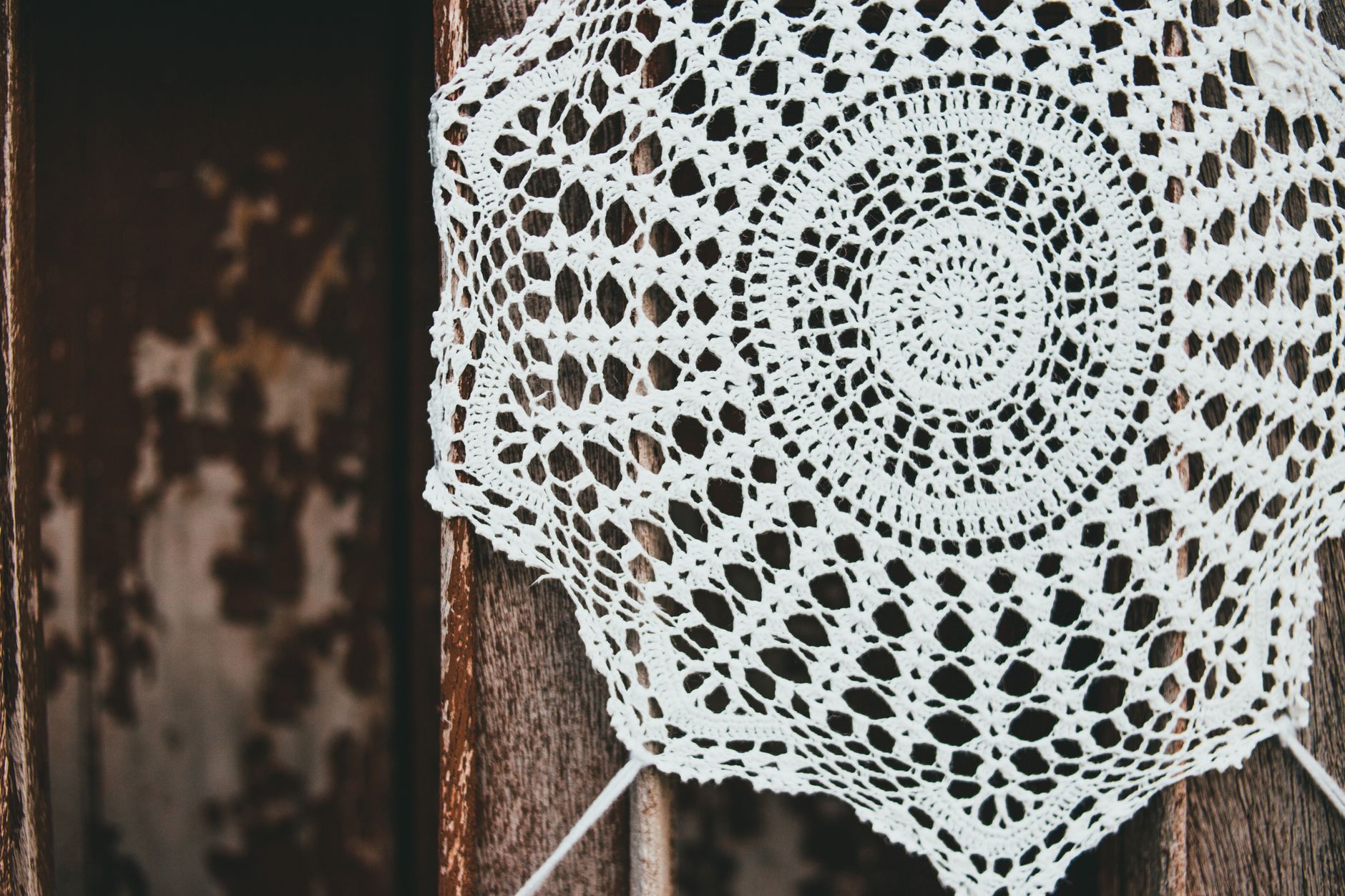
Different kinds of crochet can be organized a few different ways, but grouping them by the chart or notation style each one uses is especially useful, since it tells you immediately how to read any pattern you come across labeled with one of these names. I find this framing clicks faster for visual learners than a purely technique-based explanation. This guide organizes the major kinds by their associated chart type.

Round Motif Crochet
Granny squares, doilies, and other circular motifs use a chart radiating outward from a center point, read one ring at a time moving from the middle toward the outer edge. This is the most common chart type beginners encounter first, since round motifs are a frequent early project.
Filet Crochet
Filet crochet uses a simple grid of filled and empty squares, where filled squares represent solid double crochet blocks and empty squares represent open mesh spaces, read left to right and bottom to top exactly like a written row-by-row pattern. This technique is commonly used for lettering and simple pictorial designs.
C2C and Graphghan Crochet
Corner to corner crochet uses colored block charts read diagonally, corner to corner, matching the technique’s own diagonal block-building construction. This pairs naturally with pixel-art style designs for blankets and panels.
Tunisian Crochet
Tunisian crochet uses its own chart conventions distinct from standard crochet, often resembling a cross-stitch style grid, since the technique’s forward-and-return pass structure produces a woven-look fabric well suited to that kind of charted design.

Garment Schematic Crochet
Garment patterns use a schematic chart showing measurements overlaid on a flat diagram rather than stitch symbols, a completely different reading approach focused on finished dimensions rather than individual stitch placement.
Freeform Crochet: The Exception with No Chart
Freeform crochet, sometimes called scrumbling, deliberately breaks from any chart system entirely, since the technique is improvisational by design with no set pattern or standard notation to follow. This makes it the clear exception to the chart-based organizing framework used for every other kind above, worth mentioning specifically because a beginner searching for a “freeform chart” will not find one, and that absence is the entire point of the technique.
Frequently asked questions
How do I know which kind of crochet chart I am looking at?
Round motif charts radiate from a visible center point, filet charts use a simple filled-or-empty grid, and C2C charts show colored blocks meant to be read diagonally. Checking the pattern’s stated technique usually confirms which type you have.
Can a single pattern combine more than one kind of crochet?
Yes, a garment pattern might pair a schematic chart for overall shaping with a filet chart for a lace panel detail, so it is worth checking whether a pattern uses more than one chart type before starting.
Want to learn to read the basic symbols first?
Get comfortable with the core symbol set before tackling any of these chart types.
See the symbol reference guide