How to do second row of crochet depends on getting three things right in sequence: turning your work correctly, identifying your true first stitch of the new row, and confirming your stitch count matches your first row before continuing. Take this sequence slowly, since a mistake here compounds through the rest of the project. This guide breaks down each part in detail.
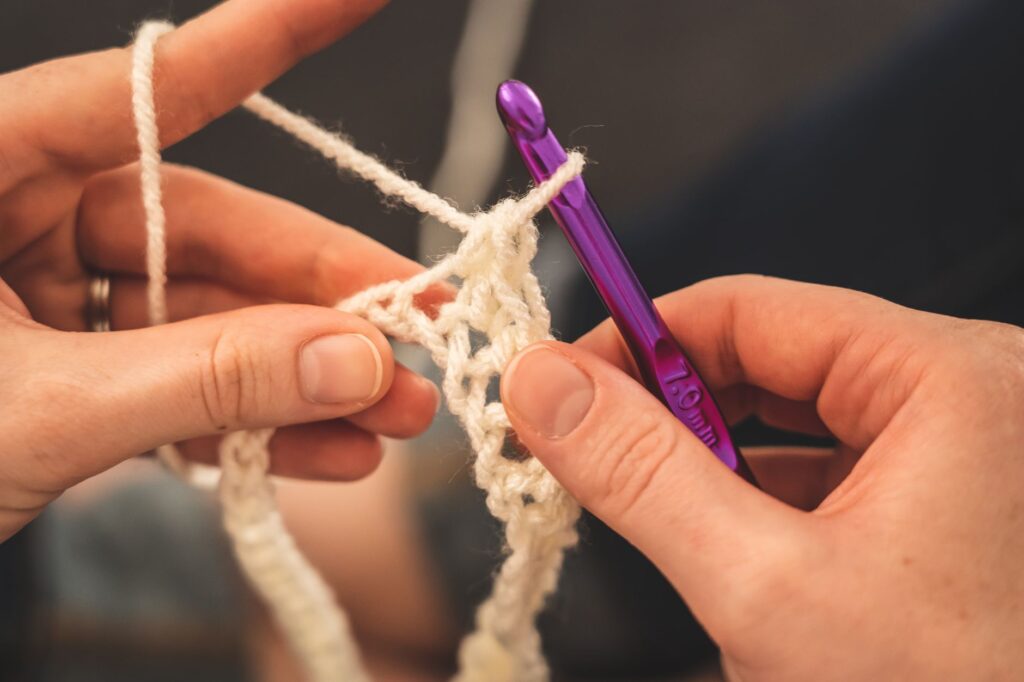
Step 1: Turn Correctly
At the end of row 1, chain the height appropriate for your stitch type: 1 for single crochet, 2 for half double crochet, 3 for double crochet. Then flip your work over so the opposite side faces you, keeping your hook in place through the last loop rather than removing it.
Step 2: Find Your True First Stitch
This is where most early mistakes happen. Whether your turning chain counts as your first stitch of the new row depends entirely on your stitch type. For single crochet, the turning chain does not count as a stitch, so your first single crochet of row 2 goes into the actual first stitch of row 1, not into the chain space. For double crochet, the turning chain usually does count as the first stitch, meaning you skip the first actual stitch of the row below and work your next double crochet into the second stitch instead.
Double-check this rule against your pattern’s notes before starting row 2 on any stitch type you have not used in a while, since assuming the wrong rule from a different stitch throws off the entire row’s count.
Step 3: Confirm Your Stitch Count
Once you finish row 2, count your total stitches and compare that number to row 1. For a simple straight-sided project like a dishcloth, both rows should match exactly. If your count is off by one or two stitches, the most likely cause is a miscounted turning chain, either treating it as a stitch when it should not count, or the reverse.

Common Second-Row Mistakes
- Skipping the actual first stitch: Confusing the turning chain rule causes many beginners to accidentally skip the real first stitch of the row below, shrinking their stitch count by one each row.
- Working into the turning chain space itself: For single crochet, working into the turning chain space instead of the actual first stitch adds an extra unintended stitch.
- Losing track of the last stitch: The final stitch of a row, often worked into the top of the turning chain from the previous row, gets missed frequently since it can be harder to spot than the stitches in the main body of the row.
A Simple Practice Exercise
Chain 15, work single crochet across row 1, then work three more rows, counting stitches out loud after each one. All four rows should land at exactly 14 stitches, since the second chain from the hook is your true starting point. If any row comes up short or long, stop and recount before continuing, since compounding a count error across four rows makes it much harder to trace back to where it started.
Frequently asked questions
Why does my second row have fewer stitches than my first?
This usually means you accidentally skipped the actual first stitch of the row below, often caused by misapplying the turning chain rule for your specific stitch type. Recheck whether your turning chain should count as a stitch before working your first stitch of the new row.
Do I need to count stitches every single row?
For a beginner, yes, counting every row until the turning chain rule for your stitch type becomes automatic is worth the extra few seconds, since catching a count error on row 2 is far easier than untangling it ten rows later.
What if I already worked several rows before noticing a count error?
Unravel back to the last row where your count was correct rather than trying to fix it going forward, since an error carried forward usually compounds and gets harder to trace the longer it goes uncorrected.
Want the turning chain reference by stitch type?
See a quick-reference table for every common stitch height.
See the turning chain reference